
Berlin, November 10, 2026
On Energy and Transport Day at COP 31, Urgewald released the 2026 edition of its Global Oil & Gas Exit List (GOGEL). GOGEL is the world’s most comprehensive public database on oil and gas companies, and covers around 1,900 companies active across exploration, production, transport, and power generation.
Around 300 financial institutions currently use GOGEL to assess portfolio exposure and design fossil fuel exclusion policies.
GOGEL 2026 data shows that 96% of upstream oil and gas companies are still exploring or developing new hydrocarbon reserves. “These companies are betting on decades of oil and gas sales that are far from guaranteed. Their expansion plans deepen the climate crisis, harm local communities and leave investors exposed to the risk of stranded fossil fuel infrastructure as the energy transition accelerates.” — Signe Moe, Senior Research Analyst, Urgewald
The 2026 Global Oil & Gas Exit List is available at gogel.org.
Türkiye’s National Oil Company TPAO Plans Upstream Expansion Surge
As delegates gather in Antalya for the UN climate summit, Türkiye’s national oil company illustrates the gap between climate negotiations and continued fossil fuel expansion. Türkiye Petrolleri AO (TPAO) has increased its expansion plans sevenfold since Urgewald began monitoring oil and gas companies in 2021.
TPAO is now developing 1.98 billion barrels of oil equivalent (bboe), making it the world’s 11th largest state-owned oil and gas developer. Its exploration spending has doubled over the last five years.
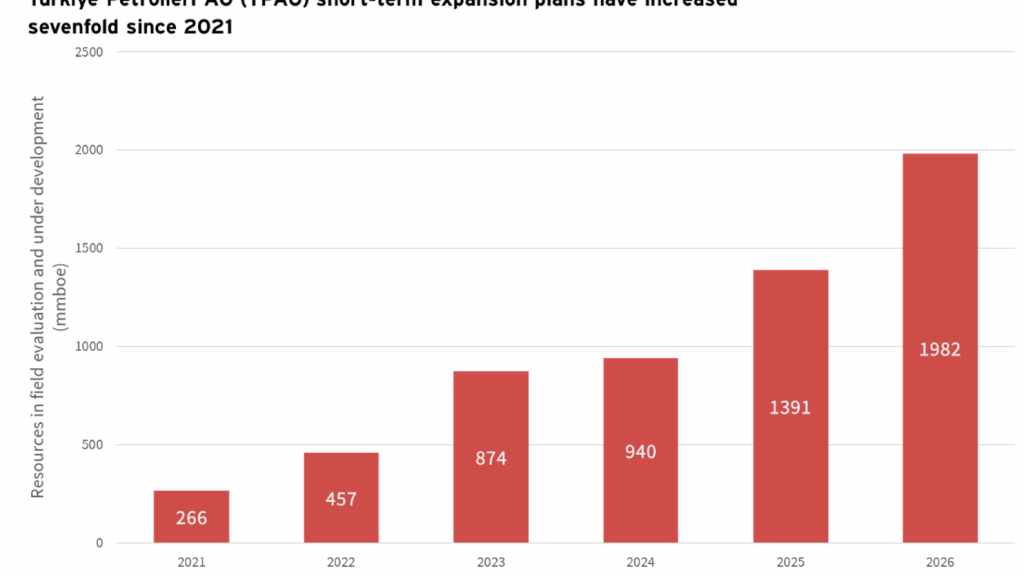
Since the beginning of 2026, TPAO signed agreements with ExxonMobil, Chevron, BP, Shell and TotalEnergies to partner in new oil and gas exploration at home and abroad. “Fossil fuels are by far the largest contributor to the climate crisis. The fact that Türkiye is massively stepping up its fossil fuel exploration and development taints the country’s leadership role at COP 31,” says Moe.
TPAO’s growth is part of a wider push to bring new oil and gas resources into production in the near term. State-owned oil and gas companies dominate GOGEL’s short-term expansion rankings. QatarEnergy leads with plans to bring 27.5 bboe into production in the next years, followed by Saudi Aramco (16.8 bboe), Gazprom (13.7 bboe) and ADNOC (13.5 bboe). ExxonMobil ranks fifth with 11.7 bboe. These figures describe oil and gas resources companies currently intend to bring into production, rather than their future annual output.
Oil Majors Abandon Weak Climate Plans and Go All-In on Expansion
GOGEL 2026 shows how oil and gas companies are actively driving the planet off a 1.5°C pathway.
GOGEL measures how much of companies’ planned expansion falls outside the International Energy Agency’s original net zero by 2050 scenario, first published in 2021. In this pathway, there is no room for new oil and gas fields beyond those that were already approved for development in 2021.
ExxonMobil’s overshoot of the IEA pathway has increased by 195% since 2022, reaching 10.8 bboe in 2026. These resources were either approved for development after 2021 or are yet to be approved. Fellow international heavyweights TotalEnergies (5.7 bboe), Shell (4.8 bboe), Eni (4.3 bboe), BP (3.6 bboe) and Equinor (3.4 bboe) also dramatically overshoot the IEA’s roadmap and are steadily moving us further away from a 1.5°C path.
ExxonMobil has the highest absolute overshoot of any major international oil and gas company, while UK major BP displays the highest relative increase of 238% since 2022.
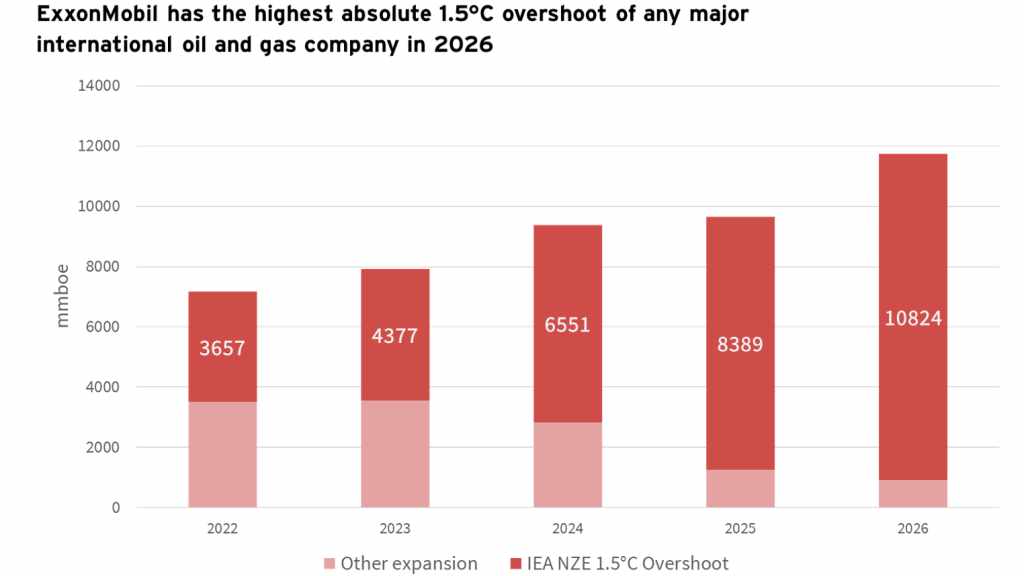
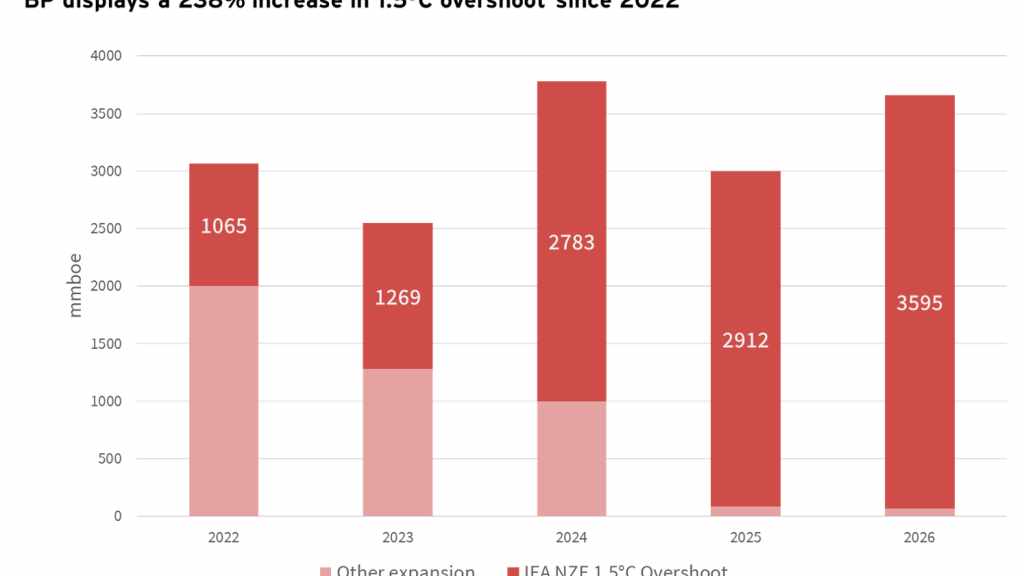
When the IEA first published its Net Zero by 2050 pathway in 2021, many of the world’s biggest oil and gas companies were eager to craft a greener image for themselves. ExxonMobil, TotalEnergies, Shell, BP, Eni and Equinor all presented net zero by 2050 plans between 2020 and 2022. Today, they have either weakened or dropped most of these promises. GOGEL’s IEA overshoot analysis, however, shows that these companies’ expansion plans were incompatible with the 1.5°C limit long before they officially began discarding their climate ambitions.
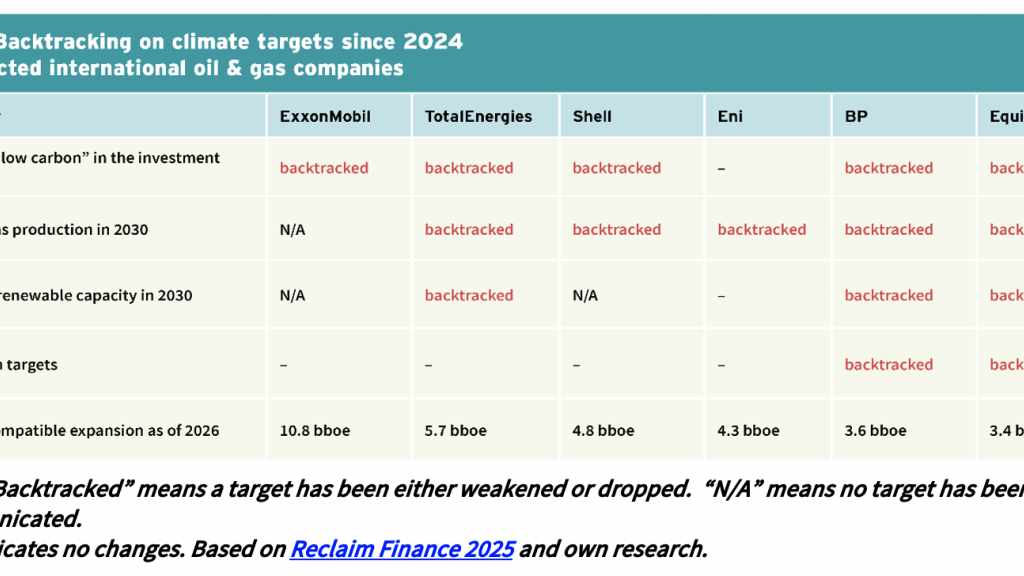
Several oil majors have sought to justify their retreat from climate commitments by pointing at others. TotalEnergies recently argued that “our societies and economies are not yet achieving the pace of change required”.
“Companies that spent decades lobbying against stronger climate legislation, scaled back their renewable energy investments, and continue spending billions of dollars on developing new oil and gas fields every year are now telling us that the transition is moving too slowly? It’s a consistent pattern we see in our research: Big Oil makes climate promises, breaks them, and then offloads the blame onto society at large,” comments Moe.
Big Tech Drives Ballooning Gas-fired Power Expansion Plans
The oil and gas industry’s expansion bet is reinforced by another sector’s inflated growth expectations: Big Tech’s AI boom. In the United States, companies are pursuing plans for 229 gigawatts (GW) of new gas-fired power capacity. The US now accounts for 30% of planned global gas-fired power expansion, up from around 20% a year ago, with a development pipeline nearly three times the size of China’s.
East Asian utilities continue to dominate the global company rankings, but US developers are climbing the list, driven in large part by the booming data center buildout. Taiwan’s Taipower has 18.2 GW of planned gas-fired capacity, followed by South Korea’s KEPCO with 17.1 GW. US utility Entergy now ranks third globally, with 12.8 GW of planned capacity after expanding its plans by 4.8 GW over the past year, up from seventh place.
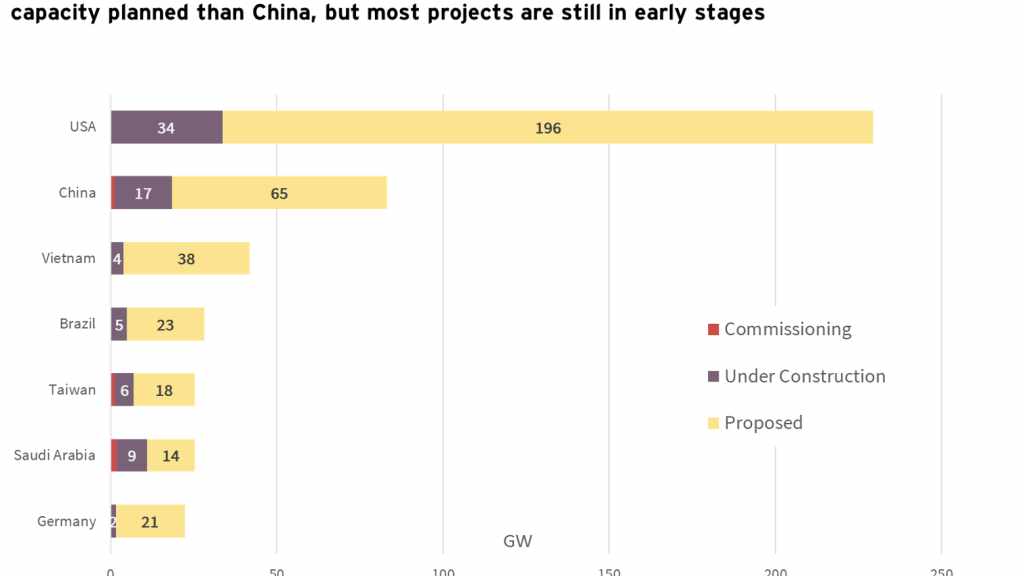
At least 40% of planned US gas-fired power capacity is directly linked to data centers. The scale of this trend is illustrated by Pacifico Energy’s GW Ranch project in Texas, which aims to supply up to 5 GW of gas-fired power to data centers, equivalent to half of New York City’s peak electricity demand of 10 GW.
“People and the planet are paying the price of Big Tech's AI data centers. Data centers increase electricity bills and deplete water supplies, while burdening communities with pervasive noise and air pollution. The expansion of AI data centers is expanding fossil fuel use so we shouldn't take seriously the AI industry leaders' hype about saving the planet,” comments Michael Khoo of Friends of the Earth US.
US Accounts for Half of Global LNG Export Expansion Plans
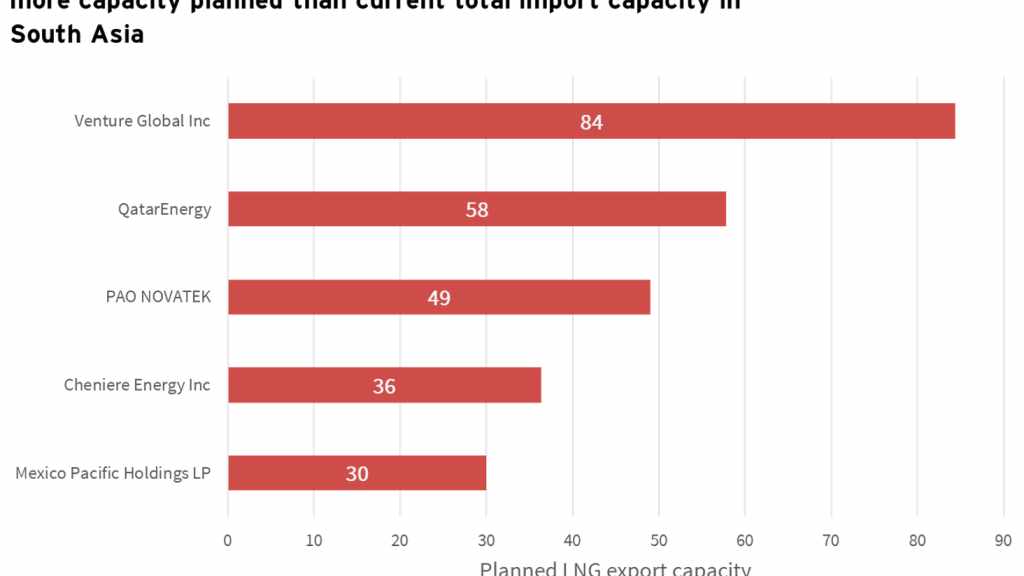
The US is the world’s largest exporter of liquefied natural gas (LNG), with most of its export terminals concentrated along the Gulf of Mexico coast. Despite warnings that future import demand could fall short of expectations, companies are poised to more than quadruple the country’s LNG export capacity. Of the 873 million tonnes per year (Mtpa) of additional export capacity planned worldwide, nearly half (434 Mtpa) is in the US.
Venture Global alone plans 84.4 Mtpa of additional LNG export capacity, more than the current combined LNG import capacity of South Asia. Other major developers include QatarEnergy (57.8 Mtpa), Russia’s NOVATEK (49.0 Mtpa), Cheniere Energy (37.7 Mtpa) and US-based Mexico Pacific Holdings (30.0 Mtpa).
Asia’s Slowing LNG Expansion Puts Export Bets at Risk
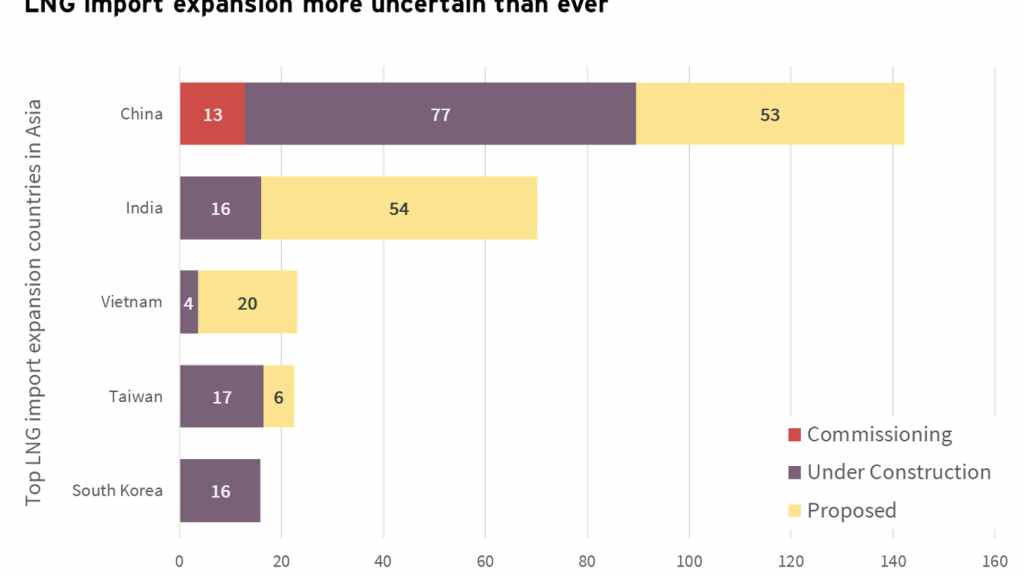
LNG companies’ export projects depend on buyers continuing to purchase large volumes of imported gas for decades to come. Today, Asia accounts for two thirds of planned global LNG import capacity. China and India are the largest developers globally. The commercial prospects of LNG export projects in the US and elsewhere are therefore heavily dependent on a sustained, multi-year demand increase in these countries.
However, supply disruptions in the Strait of Hormuz have exposed many importers to sharp price shocks. IEA Executive Director Fatih Birol has stated that the crisis could prompt countries to reduce their reliance on fossil fuels. A faster shift towards electrification and renewable power would weaken the long-term demand on which LNG export developers desperately depend.
Chinese LNG import expansion is already showing signs of slowing. Targets set out in the country’s new five-year plan, released this year, suggest that a substantial share of planned LNG import terminals may never enter operation. The five-year plan for oil and gas foresees an approximate 35 Mtpa increase of LNG import capacity, while current expansion plans amount to 142 Mtpa according to GOGEL data. This means the world’s largest LNG importer could end up abandoning nearly 75% of its planned LNG expansion.
India accounts for one fifth of planned LNG import capacity in Asia, yet only 23% of its planned capacity has actually entered construction. Many of the proposed projects are up in the air. H-Energy is one of several Indian companies that had substantial expansion plans, but has slowed down developments in recent years. Last year, it was the largest LNG import developer on GOGEL, but this year’s research confirms that projects representing 17 Mtpa are no longer progressing or have been shelved.
“Expensive LNG from overseas makes India's households and businesses vulnerable to global price spikes. Imported LNG can never compete with renewables. We are already seeing this in the sub-optimal use of LNG infrastructure like import terminals, pipelines and power plants,” commentsVidya Dinker, Executive Director of Growthwatch
The Philippines is also beginning to retreat from gas expansion. Over the past year, planned LNG import capacity and gas-fired power capacity have declined by 25–30% as projects have been shelved or canceled and decision makers increasingly turn towards renewables. The country has consequently dropped from 11th to 19th place in the global ranking for gas-fired power expansion.
“Fossil fuel dependence has cost people in the Philippines and across Southeast Asia dearly. This year’s energy crisis is adding economic distress to the damage communities already face from climate change. Shelved gas projects show that the industry cannot take future demand for granted. Governments and companies must stop tying communities to volatile imported fuels and build a just, renewable-powered future.” — Gerry Arances, Executive Director, CEED (Philippines)
The Finance Sector Needs to Break Its Bond with Oil & Gas
The finance sector is a key enabler of fossil fuel expansion. Research published by Urgewald in June 2026 found that asset managers, pension funds, sovereign wealth funds and insurers hold investments of over US$ 5.8 trillion in companies that are developing new oil and gas assets. Since 2021, a growing number of financial institutions have, however, begun to break their bond with the oil and gas industry.
One of the first movers in 2021 was the world’s 5th largest pension fund ABP. For years, the Dutch pension giant had defended its investments in oil and gas producers, arguing that engagement was the best way to push these companies to decarbonize. But lack of progress in the sector convinced ABP’s Board to change course. The pension fund subsequently sold off €15 billion in fossil fuel stocks and bonds, and committed to invest €30 billion in the energy transition. In 2024, the Netherlands’ second-largest pension fund, PFZW, followed suit and divested over 300 oil and gas companies. As Joanne Kellerman, Chair of PFZW’s Board, explained, “The intensive shareholder dialogue over the past 2 years with the oil and gas sector on climate has made it clear to us that most fossil fuel companies are not prepared to adapt their business models to Paris.”
Today, a growing number of institutional investors, including BNP Paribas Asset Management and Nordea Asset Management are denying debt to certain oil and gas companies by ceasing to invest in their bonds in the primary market. This is an important step as bonds are an essential source of external financing for oil and gas companies’ expansion plans. Further institutions made announcements in 2026. In June, the Swiss Association for Responsible Investments (SVVK-ASIR), which unites 12 major Swiss pension funds and insurers, recommended that its members stop buying debt securities of seven oil companies, after engagement efforts failed. And in September 2026, Europe’s third largest asset owner, Caisse des Dépôts, announced that it will cease buying new bonds issued by oil producers. Caisse des Dépôts manages part of the regulated savings held by more than 8 in 10 French citizens.
Since 2021, almost all of Europe’s large insurance companies have adopted oil and gas restriction policies. Several major European banks such as BNP Paribas, Crédit Agricole, ING and Danske Bank have also begun restricting their support for the oil and gas industry.
“An increasing number of financial institutions realize that the expansion plans of oil and gas companies pose a fundamental threat to our future. The rest of the finance industry needs to follow their example and stop delaying climate action on oil and gas,” comments Urgewald’s Signe Moe.
Notes
- GOGEL’s short-term expansion metric includes resources categorized by Rystad Energy as in “field
evaluation” and “under development.” Companies will start producing these resources in the near future
(i.e. in approx. 1–7 years). The exact time frame depends on the type of asset.
- The GOGEL IEA NZE Overshoot metric is based on the original scenario as published in 2021 and updated in 2022. See IEA (2022), p. 133: https://iea.blob.core.windows.net/assets/830fe099-5530-48f2-a7c1-
11f35d510983/WorldEnergyOutlook2022.pdf
- The diagrams display ExxonMobil’s and BP’s growing share of short-term expansion projects overshooting 1.5°C in red. The projects are labelled as “IEA NZE 1.5°C Overshoot” because their production contributes to additional oil and gas supply, which is not required in a world limiting global warming to 1.5°C according to the IEA NZE.
4. Data on existing LNG import capacity from Global Energy Monitor (GEM), Global Gas Infrastructure Tracker (October 2026): https://globalenergymonitor.org/projects/global-gas-infrastructure-trac…. The Five-Year Plan targets 200 Mtpa installed LNG import capacity by 2030: https://www.reuters.com/business/energy/china-sets-new-2030-targets-energy-infrastructure-development-2026-08-17/
About the Global Oil & Gas Exit List
The Global Oil & Gas Exit List (GOGEL) is a public database developed by Urgewald and published in partnership with international NGOs. It provides the most comprehensive overview of the global oil and gas industry, covering roughly 1,900 companies active in exploration, production, transport and power generation.
GOGEL allows financial institutions, governments, and civil society to identify companies whose business plans conflict with the Paris Agreement’s 1.5°C limit. Around 300 financial institutions use GOGEL to assess portfolio exposure and design fossil fuel exclusion policies.
The full dataset and methodology are available at gogel.org.
GOGEL 2026 is co-published by Urgewald and 350, 350 Japan, Amazon Watch, Arayara, Attac Österreich, BankTrack, Center for Energy, Ecology, and Development (CEED), Center for Environment Law and Community Rights (CELCOR), Centre for Citizens Conserving Environment & Management (CECIC), Centre for Environmental Rights (CER), Climate Action Network (CAN), Coastal Livelihood and Environment Action Network (CLEAN) Khulna / Bangladesh Working Group on External Debt (BWGED), Culture Unstained, Ecodefense, Ekō, Fair Finance International, Fossil Free Berlin, Friends of the Earth (FoE) France/Les Amis de la Terre, Friends of the Earth (FoE) USA, Global Energy Monitor (GEM), Green America, Green Innovation and Development Centre (GreenID), Groen Pensioen, Gulf South Fossil Finance Hub, Jubilee Australia, Just Share, Kampagne "Collapse Total", Klima-Allianz Schweiz, Laudato Si Movement, Nordic Center for Sustainable Finance, Oil Change International (OCI), Rainforest Action Network, Reclaim Finance, ReCommon, Shift Action, Sierra Club, Solutions for Our Climate, Stand.earth, SUS-POL project (University of Sussex), The PRAKARSA, The Sunrise Project.