
Berlin, September 30, 2026
A new Urgewald dataset tracks loans and underwriting from 744 commercial banks to companies operating across the thermal coal value chain. Between 2022 and 2025, these banks channeled $467 billion to the coal industry.
Financial flows to the sector are, however, highly concentrated: Chinese banks account for 62% ($289 billion), US banks for 14% ($67 billion) and Japanese banks for 6% ($28 billion) of total bank support to the coal industry.
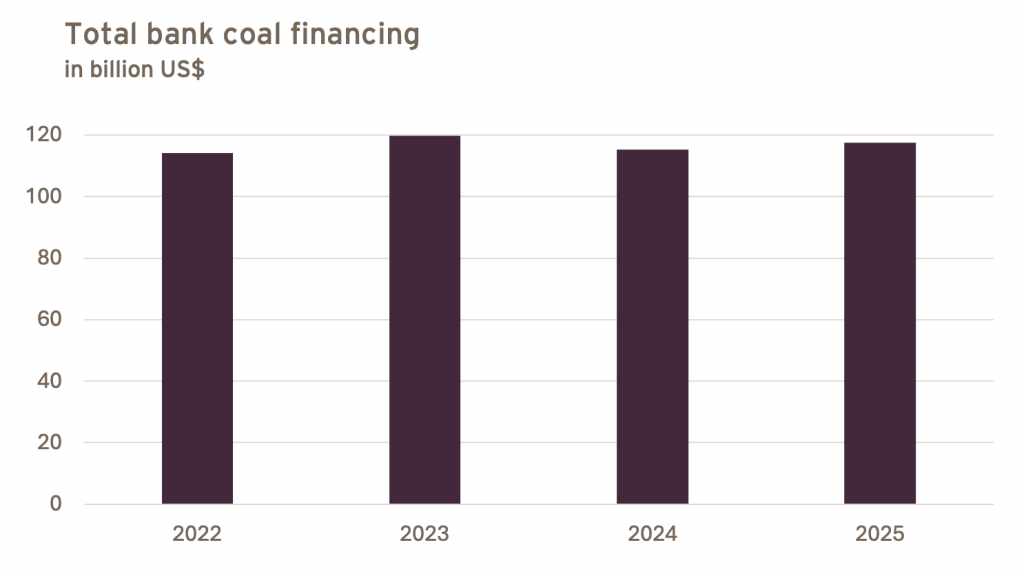
The four years covered in the dataset directly follow COP 26 in Glasgow, where governments agreed to accelerate the phase-down of coal, and financial institutions made high-profile net-zero commitments. Urgewald’s data shows that global bank financing for coal has remained broadly flat since Glasgow, averaging around $117 billion per year. But this aggregate figure masks a growing rift within the banking industry.
"Coal financing is not disappearing – but it is concentrating in banks and markets where coal policies are either missing or weak." – Heffa Schücking, Director of Urgewald
EU Banks Cut Coal Financing, While Top UK Banks Increase Support of the Industry
Banks headquartered in the EU have cut coal financing by 46%, from $4.8 billion in 2022 to $2.6 billion in 2025. Almost all EU banks which had meaningful coal exposure in 2022 reduced their support for the industry. This reduction has real consequences beyond the region, since many European banks are global financiers.
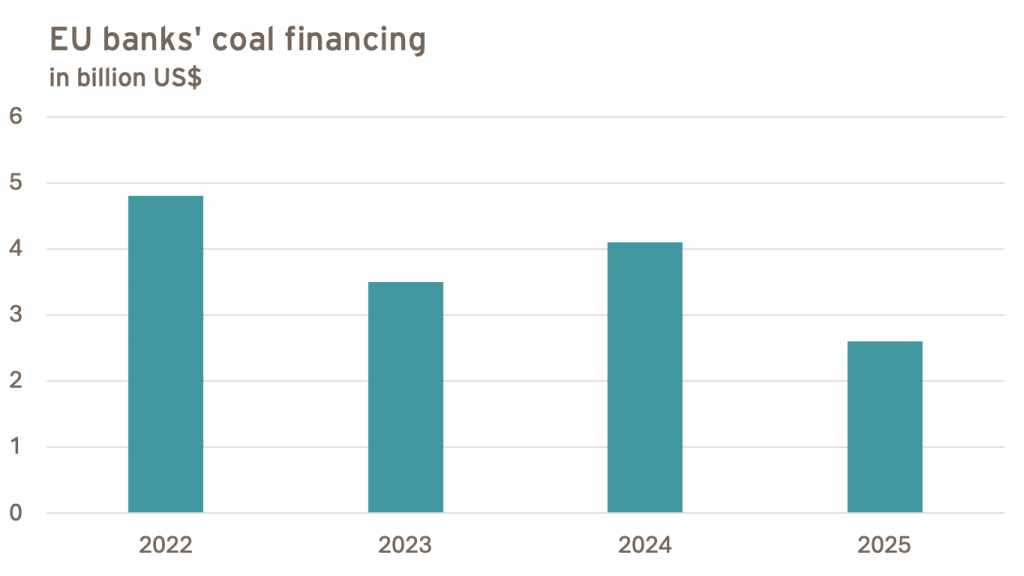
“Due to the adoption of coal restriction policies by most EU banks, financing for the industry has almost been halved. But in order to maintain and accelerate this decline, major EU laggards like Deutsche Bank and Santander, whose coal financing has remained stable, need to pull even with their peers,” says Schücking.
While total coal financing of EU banks declined, financial flows from UK banks to the coal industry grew by 17% since the Glasgow COP. This increase was, however, mainly driven by Barclays and to a lesser degree by HSBC. Barclays not only stands out as the largest coal banker in Europe, providing $5.7 billion since Glasgow, but actually increased its annual coal financing by 34%, from $1.2 billion in 2022 to $1.6 billion in 2025. HSBC started out with $200 million in 2022 and doubled its coal financing to $414 million in 2025.
A large UK bank that marched in the opposite direction is NatWest. In 2021, during the Glasgow COP, the bank announced that it would phase out lending for coal in the UK by 2024 and globally by 2030. NatWest subsequently reduced its coal financing by 50% and is a member of the Powering Past Coal Alliance, an initiative launched by Canada and the UK in 2017.
Bank Financing for Coal Declines in Several Asian Countries
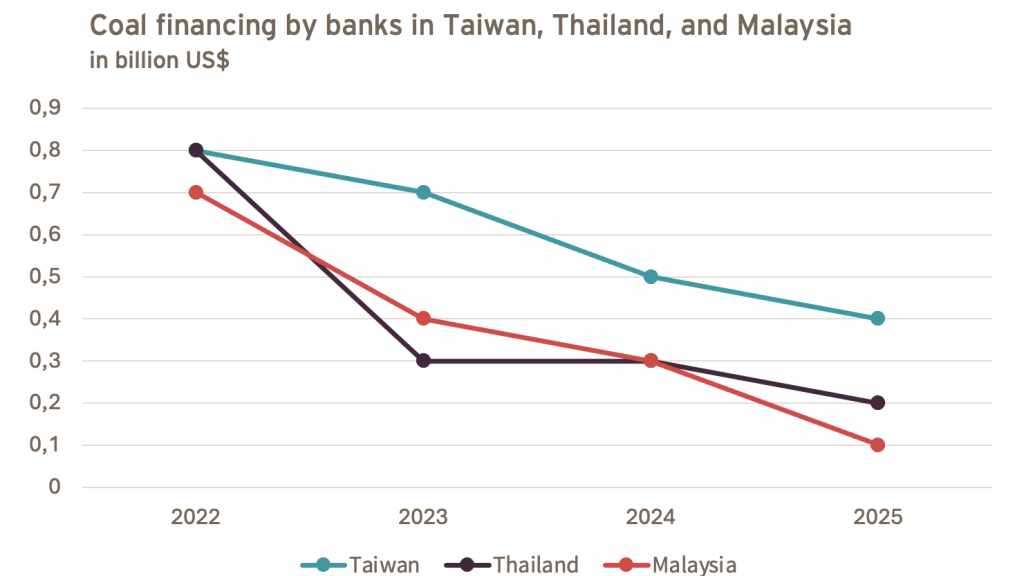
While Asia remains a stronghold of the coal industry, Urgewald’s data shows a notable decline of banks’ coal financing volumes in several Asian countries over the review period. Coal financing of Taiwanese banks dropped by 53% from $872 million in 2022 to $413 million in 2025. To date, 15 Taiwanese banks have adopted coal restriction policies and set firm coal phase-out dates.
In response to campaigns by environmental organizations, 4 of Malaysia’s largest banks – CIMB, Maybank, Ambank and RHB – adopted coal restriction policies between 2020 and 2022. Five years later, the data shows the impact of these policies. Malaysian banks reduced their coal business by 88% from $747 million in 2022 to just $92 million in 2025.
Coal financing of Thai banks decreased by 74% from $810 million in 2022 to $213 million in 2025. Since 2021, five Thai banks have adopted “no new coal” policies or set targets to reduce their coal exposure over time. Many Thai banks that still lack a coal policy, however, also significantly reduced their support for the industry.
Although India still has the world’s second-largest pipeline of new coal power projects, Indian banks’ coal financing dropped by 19%, from $3.5 billion in 2022 to $2.8 billion in 2025.
This drop likely signifies that the country’s massive build-out of solar and wind capacity is now outpacing investments in new coal capacity. Up to now, however, only 2 out of India’s top 30 banks – Federal Bank and RBL Bank – have adopted explicit coal exclusion or phase-out policies. Several others such as Axis Bank or IDFC have only made weak commitments towards limiting their total exposure to “carbon-intensive sectors”.
“Indian banks need coal policies that reflect both the severity of the climate crisis and the pace of the clean energy transition. As renewable energy becomes increasingly competitive, investments in coal become more and more risky.” – Sagar Asapur, Head of Sustainable Finance at Climate Risk Horizons
Japanese banks’ coal financing initially showed a promising downward trend, falling from $8.7 billion in 2022 to $5.9 billion in 2024. But financing rose again to $6.8 billion in 2025, signifying a partial recovery, while still remaining 20% below 2022 levels.
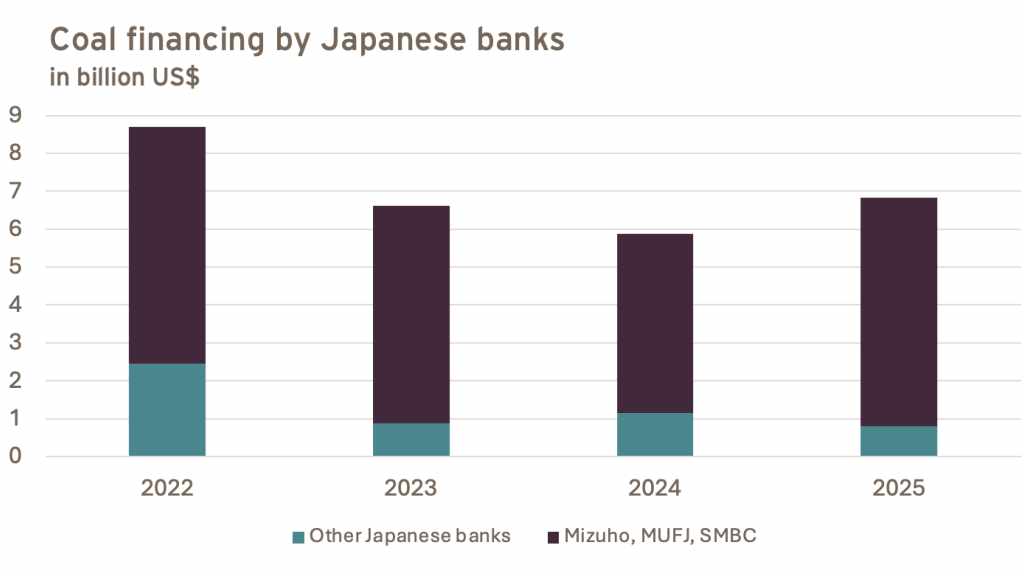
Three megabanks dominate the picture: Mizuho Financial Group ($10.5 billion), Mitsubishi UFJ Financial Group ($7 billion), and Sumitomo Mitsui Financial Group ($5.3 billion) together account for 80% of Japanese coal financing since Glasgow. The coal policies of these banks remain weak and their financing decisions are significant for the international coal fleet as well as for Japan’s domestic energy system. While none of the 3 megabanks has significantly reduced their coal financing, most of Japan’s smaller banks have cut their support for the coal sector.
The Flipside: Banks from China, the US, Indonesia and South Korea Ramped Up Coal Financing Since Glasgow
Reduced coal financing by banks in Europe and parts of Asia was offset by an increase of coal financing by Chinese, US, Indonesian and South Korean banks. As the world’s top coal financier, China looms large, accounting for over 60% of total bank flows to the coal industry. Over the past 4 years, China’s commercial banks increased their coal financing by 8% from $69 billion in 2022 to $75 billion in 2025.
top three Chinese coal banks are CITIC ($38 billion), China Merchants Bank ($22 billion), and Industrial Bank Company ($18 billion). In contrast to European, Japanese and US banks, 99% of Chinese banks’ coal financing goes to domestic companies. While a handful of Chinese banks have policies restricting coal finance abroad, only one Chinese financial institution restricts financing for domestic coal.
US banks are the biggest coal financiers outside of China. Since Glasgow, US Banks increased their support for the global coal industry by 23% from $13.6 billion in 2022 to $16.7 billion in 2025. The top US coal financier is Bank of America, which ramped up its coal financing by 62% from $1.5 billion in 2022 to $2.3 billion in 2025. Next in line is JPMorgan Chase with a 45% increase from $1.5 billion in 2022 to $2.2 billion in 2025. Wells Fargo’s coal financing jumped from $1.2 billion to $1.9 billion over the review period, an increase of 59%.
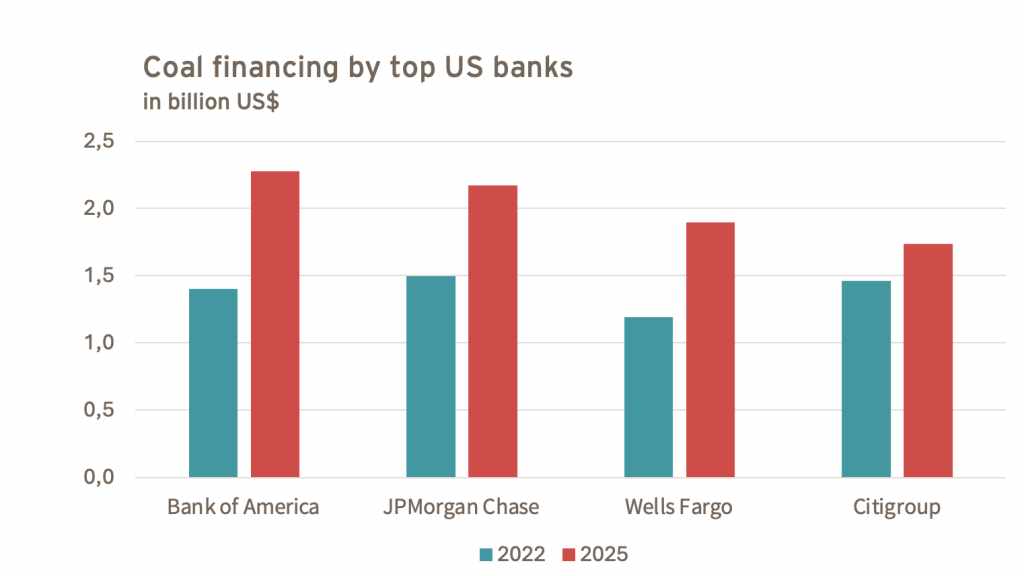
"The vast majority of banks that left the Net-Zero Banking Alliance continue to uphold their coal policies. But Bank of America and JPMorgan Chase threw their coal restrictions out the window while Wells Fargo abandoned its climate emissions targets. Now all three are doubling down on this deadly and dying fossil fuel." – Niko Lusiani, Climate & Energy Research Director, RAN
Indonesian banks stepped up their coal financing by 64% from $1.4 billion in 2022 to $2.3 billion in 2025. This mirrors the country’s ambitious coal expansion plans, but is also an attempt to fill the gap created by the retreat of international banks that adopted policies precluding funding of new coal projects. Up to now, only 2 Indonesian banks – Bank Rakyat Indonesia and Bank Tabungan Negara – have adopted coal restriction policies. Interestingly, these are the only 2 Indonesian banks that buck the national trend and show a significant decrease in coal financing since 2022.
At COP30, South Korea became the first Asian country with a large coal fleet to join the Powering Past Coal Alliance. Although South Korea committed to phasing out most of its 61 coal power plants by 2040, coal financing by South Korean banks jumped from $830 million in 2022 to $1.75 billion in 2025, an increase of 111%. Most of this growth seems to be driven by the financial needs of South Korea’s national power company, KEPCO, which still overwhelmingly relies on coal and fossil gas. Renewables account for just 3.5% of KEPCO’s electricity generation.
"Korea has signaled its intention to phase out coal and accelerate the energy transition, but the country’s financial sector remains largely stagnant. Banks continue to provide significant financing to KEPCO and other coal-related companies, often through exceptions for state-owned utilities. As long as financial institutions continue to accommodate rather than challenge delayed transition plans, they risk undermining South Korea’s climate and energy transition goals.” – Donghyun Go, Head of Climate Finance at Solutions for Our Climate
Coal Policies Matter
Five years after Glasgow, commercial banks continue to channel around $117 billion a year into an industry that needs to be phased out – by 2030 in advanced economies and by 2040 in the rest of the world. While global coal financing looks to be flatlining, the underlying data shows a growing divide within the banking sector. Banks with strong coal policies have recorded substantial reductions in coal financing. But this progress is offset by players like CITIC, Bank of America, JPMorgan Chase, Mitsubishi UFJ, Barclays and others, whose annual coal financing has grown.
“Financial regulators, civil society organizations and investors need to take note of this divide and put pressure on bad actors within the banking industry. Over 200 of the world’s asset owners and asset managers have already adopted coal restriction or coal phase-out policies. The logical next step for these institutions is to stop buying bonds of banks that are expanding their support for the coal industry,” says Schücking.
View the data on individual banks at https://stillbankingoncoal.org