
Doha, September 30, 2026
111 countries are shareholders in the Asian Infrastructure Investment Bank (AIIB); Germany is the fourth-largest shareholder and supports the bank with public funds. Since AIIB’s founding in 2015, Urgewald has been calling on the German government to honor its promises: Membership could ensure the highest environmental and social standards.

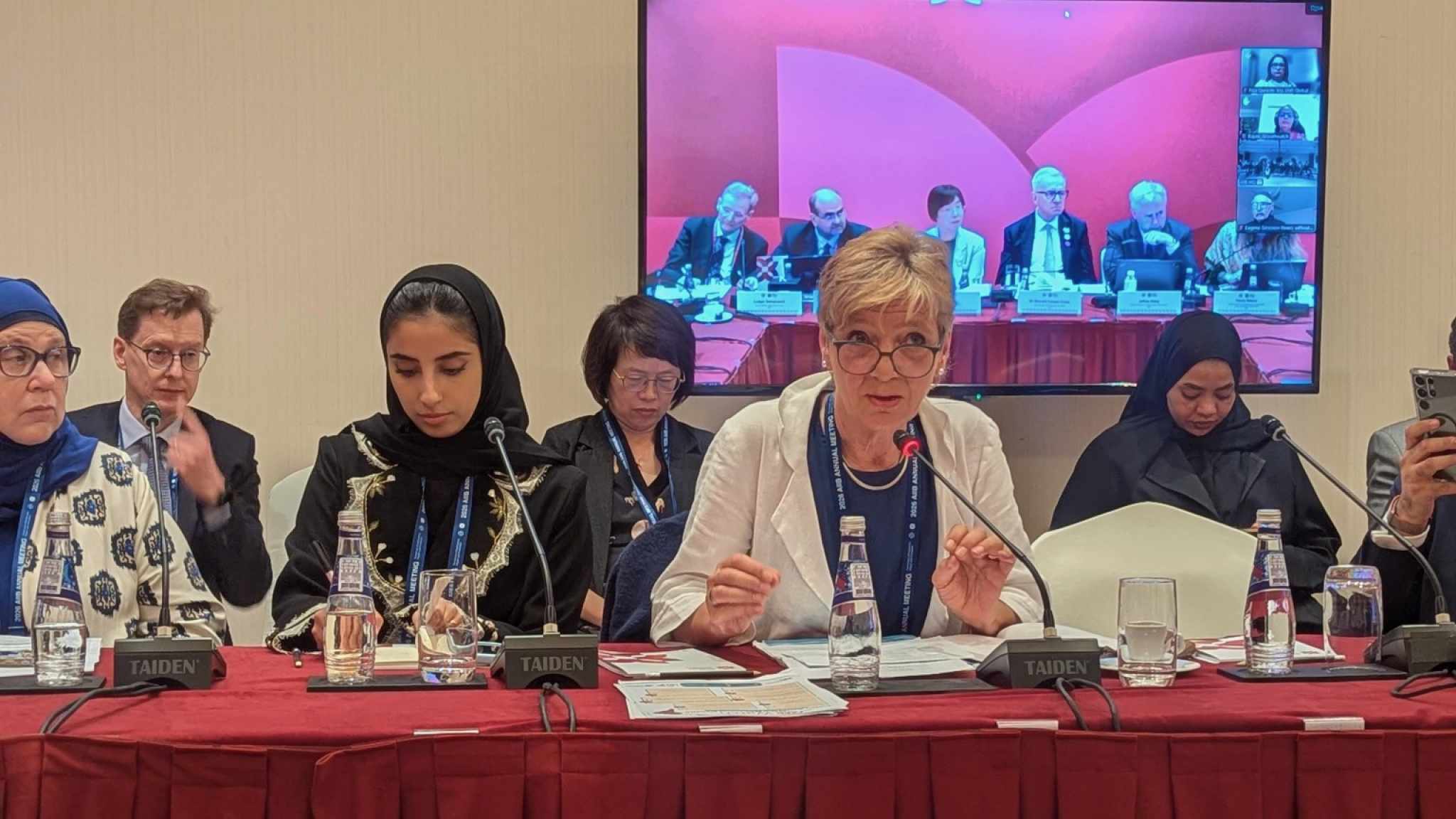
The AIIB Annual Meeting took place in Doha, Qatar, on September 28–29, 2026. Urgewald campaigners Dr. Nora Sausmikat and Merete Looft were on site to advocate for the bank’s divestment from fossil fuels and for high environmental and social standards. Alongside Oxfam Hong Kong, they were the only non-Qatari civil society representatives. Our focus: Many years of monitoring through AIIB Watch have provided us with empirical evidence of transparency gaps and the bank’s failure to comply with its own standards. In particular, new so-called “climate finance” initiatives worth billions, such as the Climate-Focused Policy-Based Finance (CPBF) instrument, earn criticism for their lack of regulations regarding climate-damaging energy sources.
The annual meeting was held under the unofficial motto “scaling up”: “More sustainable infrastructure,” more impact, more innovation, more member countries, more investments. However, AIIB, more than any other bank, has a disclosure problem regarding where the billions it has disbursed to date have gone: Urgewald’s report “Billions Beyond Control” points out that the bank invests billions of public funds in fossil fuels without complying with information and disclosure requirements or tying alleged climate finance to verifiable conditions and the 1.5-degree limit.
In 2027, the bank will revise its energy strategy. We were involved in the first revision in 2023 and offered a critical assessment: fossil gas and liquefied natural gas (LNG) must no longer be considered bridge technologies; their production must end. To this end, the indirect financing of coal, oil, and gas through financial intermediaries must also stop and end up on an exclusion list.
Despite stricter regulations on gas, we repeatedly find that the bank’s own guidelines (e.g., on due diligence) are not being followed. While a commitment to seek alternatives to gas exists, these reviews are not conducted seriously, disclosure requirements are not met, and affected local communities are not informed or consulted—even though this is a requirement under the environmental and social standards. In our view, the “Climate-Focused Policy-Based Finance” (CPBF) instrument, which mobilizes private capital, represents an unambitious token effort toward sustainability and climate protection. The generously funded government budget allocations are declared to be purely climate finance, even though there are no exclusion mechanisms for fossil fuels whatsoever. At our urging, necessary details regarding review mechanisms for the Indonesia CPBF, which was approved shortly before the annual meeting, were published. The term “renewable” does not appear even once in the entire 88-page document.
Nevertheless, the financial support of significant parts of the fossil fuel industry (including extraction, power generation, fossil industrial expansion, dedicated fossil infrastructure, or infrastructure creating carbon lock-in) is excluded. The implementing company is required to report on this. The other 19 CPBF projects listed in our report, which account for a total of $7.3 billion, have not yet uploaded similar project documents. The fact that this project document was only uploaded after approval confirms our fundamental criticism of the bank’s failure to comply with its reporting and disclosure obligations. Together with Recourse, we have pointed out that climate finance excludes neither fossil fuels nor nuclear power, is not tied to the 1.5-degree limit, relies solely on Nationally Determined Contributions (NDCs), and is exempt from most environmental and social standards.
We are calling for civil society participation in the upcoming review of AIIB’s 2027 Energy Strategy. To that end, we spoke with the new AIIB president in Doha. We emphasized that a review of private banks’ energy policies worldwide has not resulted in any relaxation of regulations regarding oil and gas restrictions. Likewise, as a public bank that manages taxpayer funds, AIIB should not allow any backtracking and should definitively rule out gas as a bridge technology.
We take home a partial victory: After a brief discussion, the AIIB president welcomed Urgewald’s proposal to hold in-depth consultations in Beijing with civil society representatives and management on the necessity of investing in “gas” as a bridge technology, ahead of the revision of the 2027 Energy Strategy. Another success: While we were still in Doha, missing documents regarding the Bank’s climate financing were uploaded to its website.
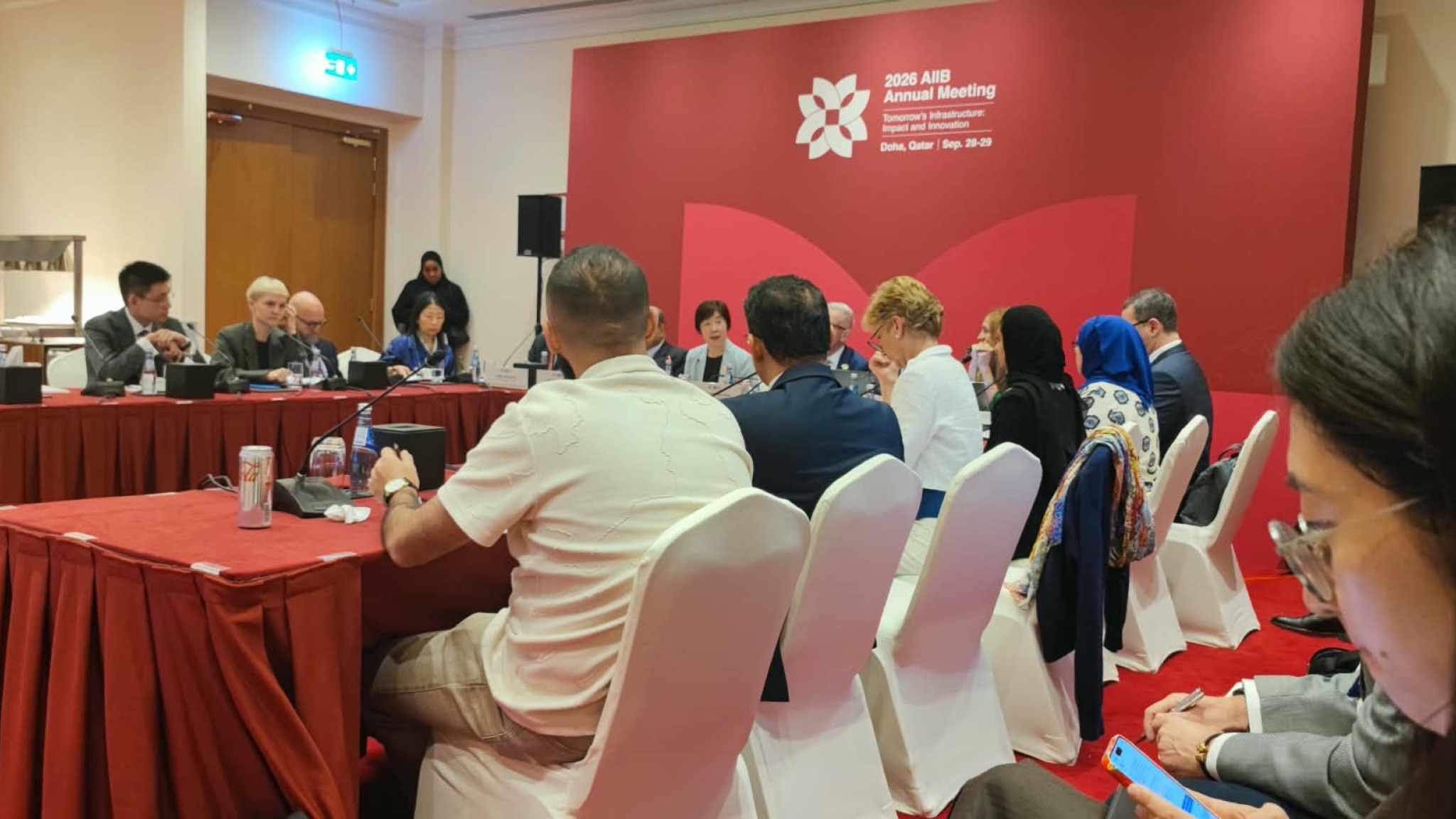
In subsequent meetings with senior management, the complaints mechanism, and individual European shareholders, we voiced our concerns and those of our partner organizations in Asia and Latin America. A major turning point under the new president is the so-called “scaling up” and the bank’s global orientation, which is now being aggressively pursued. African and Latin American members, in particular, are to be admitted. This entails greater risks and an increasing role for the bank’s accountability and complaint mechanism. Well-known issues, such as the mechanism’s still-unresolved but necessary independence, were discussed. This independence is set to be achieved by 2030. However, the complaint mechanism’s lack of resources and inaccessibility continue to pose a major reputational risk. AIIB is the only bank in the world that has not accepted a single complaint since its founding. With the admission of additional countries from Africa and Latin America, these weaknesses will intensify. A ticking time bomb.
World Bank and AIIB
A few days after AIIB’s annual meeting, the World Bank and the IMF held their annual meeting in Bangkok. Shortly before that, the World Bank’s Climate Action Plan was on the verge of expiring but was extended – and simultaneously gutted – at the last moment. In Bangkok, climate protection was not on the agenda; on the contrary, President Banga emphasized the important role of fossil gas in countries’ energy mixes and dismissed wind and solar energy as “supplementary energy sources.” The World Bank remains the largest financier of fossil fuels among the multilateral development banks (MDBs), which have provided $19 billion in direct financing for oil, coal, and gas since the Paris Agreement. At the conclusion of the World Bank meeting, President Zou Jiayi signed an agreement with the World Bank on cooperation in the area of “sustainable infrastructure.” The agreement explicitly highlights the CPBF, a budget support program geared toward private capital, as one of four core areas of cooperation. Urgent adjustments are therefore needed if the label “sustainable infrastructure” is not to be undermined by investments in fossil fuels and nuclear power.
Is a New Dynamic Possible?
Overall, we were pleasantly surprised by how proactively the management and the president welcomed us. The president expressed a desire for a “strategic partnership” with civil society so that the bank could continually improve. Whether this openness is more than just window-dressing will be evident from whether there is actually an in-depth, substantive exchange with civil society on the topic of fossil gas. AIIB could resist the World Bank’s wide-open doors to fossil gas and nuclear power; the fear is that the CPBF is paving the way for World Bank investments. For real improvement, the further development of the grievance mechanism and adherence to accountability requirements will be crucial. At present, we see no signs of this; on the contrary, the bank is increasingly exhibiting the characteristics of an investment bank. According to the IEA, Azerbaijan, which relies on gas for 65% of its energy, will host the annual meeting in 2027.